he USA vs Brazil Warm-up Match carried more weight than its exhibition label suggested. Played against one of international football’s most technically demanding opponents, the contest gave both coaching staffs a useful measure of how their squads respond when possession is scarce, passing lanes close quickly and every defensive hesitation is punished. For the United States, the occasion was less about producing a polished ninety minutes than proving that its developing core can handle pressure without abandoning its identity. Brazil arrived with the familiar expectations of control, flair and individual invention。but the match also served as a practical examination of its depth. Warm-up fixtures rarely offer competitive points, yet they often expose problems that tournament football magnifies.The USA vs Brazil Warm-up Match immediately highlighted the contrast in style. The American side tried to build with urgency。using quick forward passes and aggressive movement from wide areas, while Brazil appeared more comfortable slowing the tempo before accelerating through midfield. That rhythm created an intriguing battle. Whenever the United States pressed in numbers, Brazil attempted to bypass the first line with one-touch combinations. When the Americans held their shape, Brazil searched for gaps between the fullbacks and central defenders. The result was a match shaped by small decisions rather than constant attacking spectacle. A misplaced pass near the center circle could turn into a counterattack within seconds, and several sequences carried the intensity of a competitive fixture despite the friendly setting.For the United States, the clearest lesson from the USA vs Brazil Warm-up Match was the importance of composure after possession changed hands. The team’s best moments came when it recovered the ball and moved forward before Brazil could reset. Those attacks were direct without being reckless, particularly when midfielders supported the striker instead of leaving the front line isolated. The weaker spells arrived when the American buildup became predictable. Brazil’s players read sideways passes quickly and used their positioning to force play toward crowded areas. That is where the difference between a promising team and a mature tournament team becomes visible. Talent can create an opening, but disciplined movement determines whether that opening becomes a real chance. The United States also had to manage the emotional side of the occasion。because chasing the match too eagerly would only give Brazil more space to exploit.
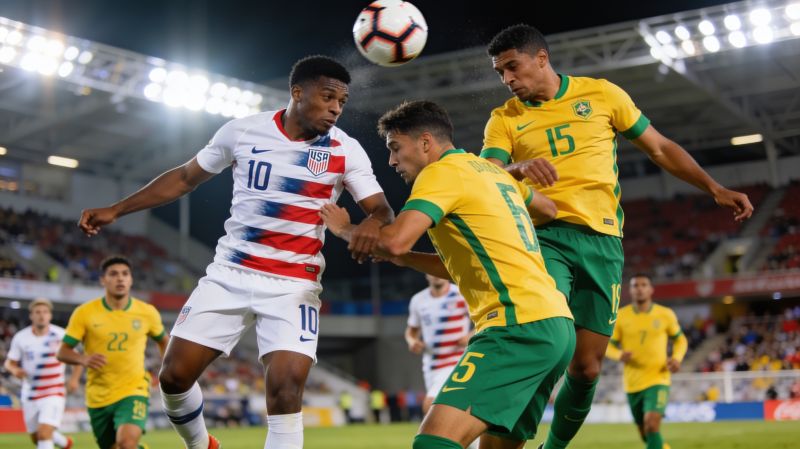
Brazil’s performance offered a different set of clues. The USA vs Brazil Warm-up Match allowed its coaching staff to test combinations that might not appear in a high-stakes qualifier, especially in midfield and along the flanks. Brazil looked most dangerous when its attackers rotated positions instead of waiting in fixed lanes. One player would drop toward the ball, another would run beyond the back line, and a third would drift inside to pull a defender away. That movement forced the United States to make repeated choices, and uncertainty often created the opening Brazil wanted. Still。the South American side was not flawless. Periods of casual passing gave the Americans opportunities to press, while an occasional lack of protection behind the ball left Brazil vulnerable to quick transitions. Those details matter because a stronger opponent will convert such moments more efficiently.The broader value of the USA vs Brazil Warm-up Match lies in what it reveals before official competition begins. Coaches can study whether their teams maintain structure when tired。how substitutes change the tempo and which players remain reliable under sustained pressure. Supporters may remember a goal or a spectacular save, but staff members will focus on less glamorous details: the distance between defensive lines, the timing of a fullback’s recovery run and the quality of the first pass after a turnover. In that sense, the USA vs Brazil Warm-up Match functioned as a live diagnostic rather than a simple showcase. The United States gained a demanding rehearsal against a side capable of punishing loose habits, while Brazil received a physical and tactical test from an opponent willing to challenge its buildup. The final verdict may depend less on the score than on which lessons each team carries into its next meaningful fixture.